Traditional construction models often separate design and construction into different phases, leading to communication gaps, schedule delays, and budget inefficiencies. In response, integrated design-build delivery has emerged as a more efficient solution for modern healthcare development.
Our recent institutional healthcare projects demonstrate how unified collaboration between architects, engineers, and construction teams can significantly improve project speed, coordination, and quality.
What Is Integrated Design-Build?
Integrated design-build is a project delivery method where a single unified team manages both design and construction from concept through completion.
Unlike traditional workflows where contractors are involved only after the design phase ends, the design-build approach enables continuous collaboration from the beginning of the project lifecycle.
This model allows critical decisions regarding structure, systems, materials, and scheduling to happen simultaneously rather than sequentially.
Reducing Construction Timelines
In large healthcare facilities, delays can directly impact patient care availability and operational planning. By integrating all disciplines under one delivery framework, project phases can overlap strategically.
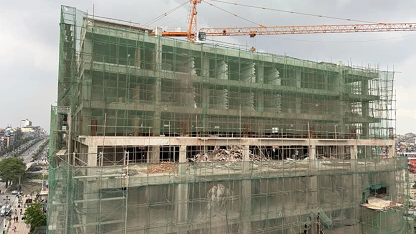
For the Kathmandu International Hospital expansion project, the integrated workflow reduced the overall construction timeline by approximately 15%.
Several factors contributed to this acceleration:
- Early contractor involvement during schematic design
- Faster approval and revision cycles
- Improved coordination between structural and MEP systems
- Real-time budgeting during design development
- Parallel procurement and construction sequencing
This streamlined communication reduced bottlenecks that commonly occur in conventional project structures.
Coordinating Complex Healthcare Systems
Hospitals require sophisticated infrastructure far beyond standard commercial buildings. Every department depends on interconnected systems including:
- HVAC and air filtration
- Medical gas pipelines
- Emergency power systems
- Specialized operating room ventilation
- Infection control environments
- Digital healthcare infrastructure
Through integrated design-build coordination, engineering teams were able to resolve system conflicts early using BIM-based clash detection and collaborative planning sessions.
This minimized expensive field modifications during construction and improved overall system reliability.
Improving Cost Predictability
One of the major benefits of integrated delivery is enhanced financial transparency.
Because contractors and engineers collaborate throughout the design phase, construction feasibility and cost implications are evaluated continuously rather than after documentation is finalized.
This process helps:
- Reduce unexpected change orders
- Improve procurement planning
- Optimize material usage
- Maintain realistic scheduling expectations
- Increase budget certainty for stakeholders
For institutional healthcare projects funded through public-private partnerships, cost predictability becomes especially important.
Enhancing Quality Through Collaboration
Integrated teams create stronger accountability across all project phases. Architects, structural engineers, consultants, and construction managers work toward shared performance goals rather than isolated contractual responsibilities.
This collaborative environment improves:
- Design consistency
- Construction accuracy
- Communication efficiency
- Risk management
- Long-term operational performance
Healthcare facilities particularly benefit from this approach because operational requirements often evolve during construction.
The Future of Healthcare Construction
As healthcare demands continue to grow, speed and adaptability will become even more critical.
Future hospitals will increasingly rely on:
- Modular prefabrication
- Smart building systems
- Flexible patient care layouts
- Energy-efficient infrastructure
- Digitally coordinated construction workflows
Integrated design-build delivery provides a framework capable of supporting these evolving requirements while improving efficiency and reducing project complexity.
By combining design innovation with construction expertise from the earliest stages, healthcare infrastructure can be delivered faster, smarter, and with greater long-term value.